



A Legacy of Collaboration
Wunmi Olaiya and Ronald K. Brown
Interview conducted by Laura Diffenderfer
For 40 years, Ronald K. Brown/EVIDENCE has seamlessly melded traditional African and Afro-Cuban dance with contemporary movement and spiritual storytelling. Woven into the timeline of Founder & Artistic Director Ronald K. Brown's vast repertory are the deep connections with many exceptional artists that have influenced his work. Each year, the company's programming reflects this history and pays homage to the beautiful artistic voices reflected in his canon.
During its homecoming run at The Joyce February 24-March 1, 2026, EVIDENCE will honor two women who have impacted his work—Program A celebrates longtime collaborator Ibiwunmi Omotayo Olaiya, while Program B honors life and legacy of the beloved Toni Pierce-Sands.
A composer, costume designer, dancer, and visionary artist, Wunmi Olaiya—who goes by Wunmi—has helped to shape the company’s sonic, visual, and movement language since the early 1990s.
Born in London and raised in Lagos, Wunmi has also created costumes for Nora Chipaumire, Urban Bush Women, Alvin Ailey Dance Company, and the Grammys, earning two 'Bessie' Awards for her work with Marlies Yearby and Brown.
Her contributions to Brown’s work will be on view in Program A, which will include Ebony Magazine: To A Village, Clear As Tear Water, Gatekeepers, and Upside Down, which Wunmi will perform live alongside her two drummers.
Laura Diffenderfer sat down with Wunmi to learn more about her collaborations with Brown and EVIDENCE over the last four decades.
When did you and Brown first meet? Did you plan to collaborate right away, or how did your creative relationship evolve?
Ron and I first met early 1993 at an event curated by our mutual friend Marlies Yearby (Broadway Rent choreographer). Marlies Yearby’s events were extremely special because it was where artists of various talents got to showcase what they do, and we got to see each other doing what we love. Ron and I became friends; he invited me over when he had his Sunday brownie and cookie gathering. Oh my gosh, he made the best brownies, it was not to be missed; everyone showed up. Ron and I started going to house music clubs after taking our favorite African dance classes. I used to make clothes for myself and my partner at the time. Ron saw the clothes I made for my partner and commissioned me to make trousers and shirts for him.
In 1995, the relationship I was in fell apart. I shared with Ron what was going on, and one day he invited me over to his apartment. To my surprise, he had cleared out his home office and offered me a place to stay. I asked him to let me design and make his company costumes in exchange, as I had no steady income at the time. And so began our collaboration. At this same time, I had also started working on my music demo, and I would come home to share my music with Ron. We would both geek out, dancing as I played my new songs. It was truly a magical period, sharing my music with Ron and designing the costumes to go with each new piece he created. It was like we had our own little world. And as he started placing work on other dance companies, he informed them that he had his costume designer. He trusted in my vision for his work.
At The Joyce, EVIDENCE will perform four works you collaborated on. Do any memories come to mind about your collaboration with Brown on these works?
Ebony Magazine: To A Village (1996) was originally placed on Cleo Parker Robinson Dance Company in Denver. When Ron informed me that he was creating a new dance for them and would like to use my song What a See, a quirky Afro fusion, drum, and bass music with many layers. Ron loved it from the moment I shared it with him. I was on tour in Europe dancing with Ornette Coleman. Ron and I had already established a routine: when he was creating new choreography, he would share poetry and notes he had written to give me insight into the heart of the dance. This was the first piece he was using my music for, and I was also to design the costumes. I went shopping for the fabrics for the costumes in London and created the costumes upon my return to NY. Then I traveled to Denver, Colorado for the first time ever. The whole process was magical…truly in the title of the song: WHAT A See.
Upside Down (1998) was part of a longer work, Destiny, that Ron originally choreographed in collaboration with Rokia Koné and her company Jeune Ballet d’Afrique Noire. For this collaboration, I traveled with Ron and EVIDENCE to Ivory Coast. This was my first time visiting Ivory Coast. I took company dance workshops, and when the company went into rehearsal, I went to Abidjan market to source fabric for the costumes. By being there during the whole creative process and watching the work come together, I was able to visualize and see the vision Ron wanted for the costumes… and also to compose and sing the title song for the work, an extra musical segment to the already pre-recorded soundtrack, which featured my rework of Fela Kuti with Masters at Work.

Wunmi Olaiya and Ronald K. Brown in Abidjan, Côte d’Ivoire (1998).
You have worked in so many different art forms—from fashion to dance to music and more. Do you think of each discipline as separate, or do they weave together? How so?
For as far back as I recollect, dance and fashion have been my tools of engagement with the outside world. I taught African dance for eight years, where I also created all the costumes for my students. It was pure joy. Both dance and designing allowed me to share stories without words. It all made sense when music came into my orbit, though I did not initially pursue music (music was the boyfriend I did not want but chased me till I stopped running and said, “ok!”).
Music gave me the platform to showcase all three aspects of my creativity unapologetically. Each discipline supported the other: when I think about music, I see visuals and movements; and when I dance, I hear rhythm, which leads to melodies. Working with Ron gave me the platform to use designs to convey stories.
Your parents were both born in Nigeria, and although you were born in the UK, I read that you spent much of your childhood in Lagos, Nigeria. How did your upbringing—and your time in Nigeria— inform your creative work?
My father sent me to Lagos, Nigeria at age four to my grandma (his mother), who resided at Ilojo Bar, also called Olaiya House or Casa da Fernandez, a Brazilian-styled historic building located in front of Tinubu Square. My memories from this period are of me looking out onto Tinubu Square from the balcony in the heart of downtown Lagos! I was full of excitement watching all the various colored buses and people on the streets—people watching was my thing! The way they dressed, the colors they wore—I started very early planning what I would wear based on the colors I saw.
My late, famous highlife musician uncle, Victor Olaiya, had a musical instrument store at the bottom of the house. Every day music was playing, and I would dance my heart out. I left Nigeria at age 14…those who knew me then shared that I danced at every opportunity I had. I did not do much talking; I was an introvert. But once music came on, no matter where I was, I would dance. Dance followed me back to England and into the life of Jazz Funk master Roy Ayers. My years in Lagos honed my love for dressing to impress. I grew up listening to Fela Anikulapo Kuti’s music alongside music from Jamaica and the USA. I loved music that spoke on social issues as well as being funky and made for dancing. My music sensibility and my style of dance and colorful outfits were definitely inspired by the synergy of Lagos.
Did you and Ron ever face a big creative challenge? What was it and how did you find your way through?
Truth be told, we never really faced a creative challenge. Our working relationship from the start was built on complete trust. Ron’s total trust that I would deliver costumes that helped further tell the story of his work gave me wings to fly and design with confidence. I did not put my portfolio out for any other costume work, as I was juggling enough with my music, teaching dance, and creating designs for my small brand.
By the early 2000s, Ron and EVIDENCE were on a roll. Ron had work commissioned from many of the top Black dance companies, and I got called in to design their costumes. It was like Bonnie and Clyde—where he went, I followed. By this time period, a lot of EVIDENCE’s repertoire featured my music and costumes and when the opportunity came for Ron to create the second part to Grace, he felt that as I was the designer for Grace, I should also get to design the new work titled Mercy.
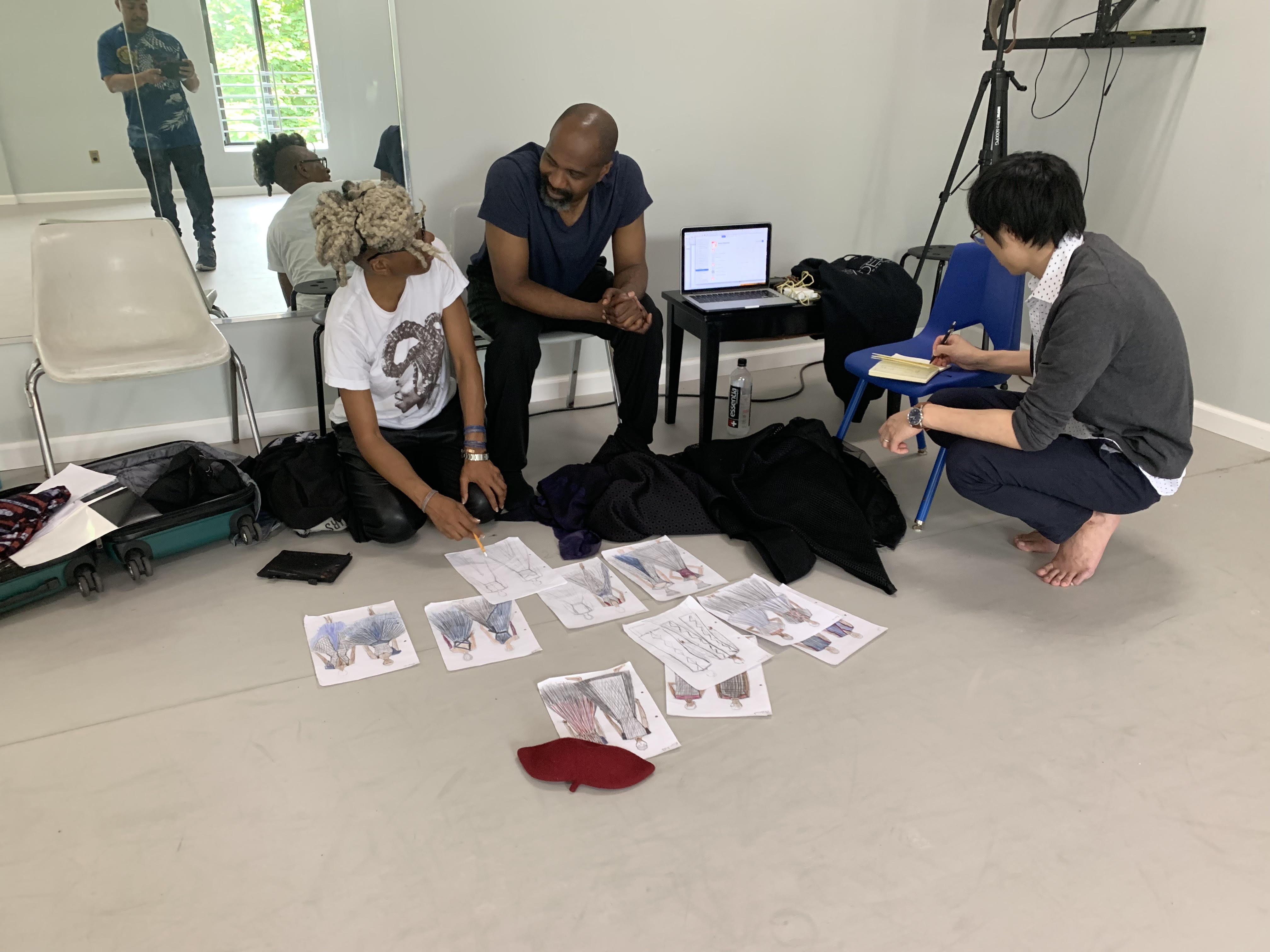
Sharing sketches during "Mercy" creation.
When I received the call, I was in New Orleans vending at the New Orleans Jazz Festival. I had traveled from London, UK, where I had been caring for my father. They explained their plans and schedule, and I was not able to fully commit, as I had relocated to London to care for my father. Ron and Arcell explained to me that the company was going to be in the UK performing in Leicester. It was like the universe was conspiring to make this collaboration work. I agreed to come see them in Leicester, where my middle sister also lived. During that meeting, we discussed the new work and production schedule—the key to all of our previous collaboration was trust, and once I felt this and Ron’s willingness to work with me long-distance, our creative synergy flowed once again. The obstacles we faced with regards to logistics all melted away.
I told him if Zinda Williams (costume designer and builder) was available to help build the costumes, I would accept the project. She said yes, and the rest is history. Designing the costumes for Mercy this time round came from me digging into the journey we had all gone through to arrive at that point in time. My father passed away two months before the opening of the show. I was therefore able to be there during the building of all the costumes. One of the male dancer’s costumes included my beloved father’s kufi hat.
.jpg)
Zinda Williams, Wunmi Olaiya, and Ronald K. Brown during "Mercy" creation.
How would you describe your creative process working with Brown over the years? Has it changed over time?
With the TRUST Ron affords me, I dare to dream and visualize what the work he is creating is speaking on. Ron tells stories of human beings making their way… and, in there, I create costumes to make them visible. Thankful, trust is alive and well.
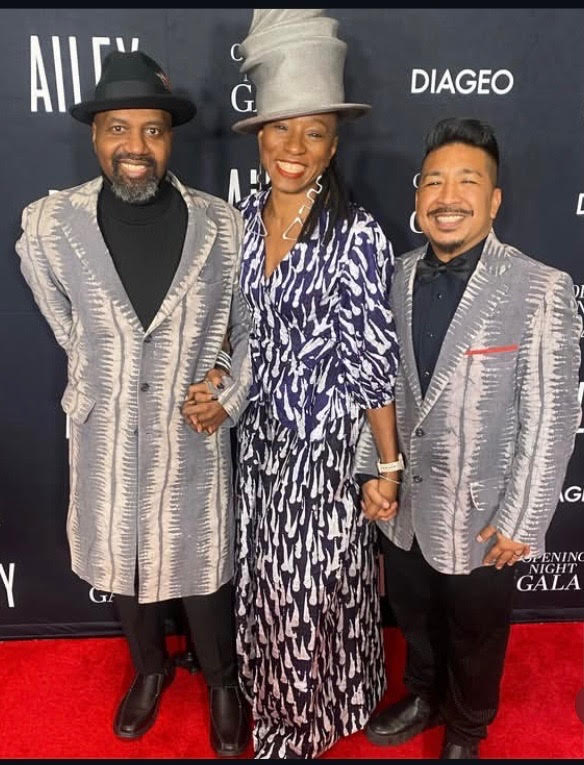
Ronald K. Brown, Wunmi Olaiya, and Arcell Cabuag at Alvin Ailey American Dance Theater's Opening Night Gala 2024.
See EVIDENCE’s Program A: Celebrating Wunmi at The Joyce on Tue Feb 24, Wed Feb 25, and Sat Feb 28 at 7:30pm & Sun Mar 1 at 2pm
AND Program B: A Celebration of the Life and Legacy of Toni Pierce-Sands on Thurs Feb 26, Fri Feb 27, and Sat Feb 28 at 2pm (Family Matinee).
Explore Wunmi’s music at wunmi.bandcamp.com and her fashion at wowwow.wunmi.com.